
Employee attendance system — every arrival logged automatically
An attendance system records when your staff arrive and leave using a face recognition camera or an entry terminal. Every event lands on a real-time dashboard, and the results are pushed to a Telegram bot. Innosoft installs these systems in Tashkent from 8 mln UZS (up to 20 employees, terminal), or from 18 mln UZS with face recognition. The Basic package goes live in 3–7 days.
Updated: July 2026 · Written by the Innosoft engineering team, Tashkent
What is an attendance system?
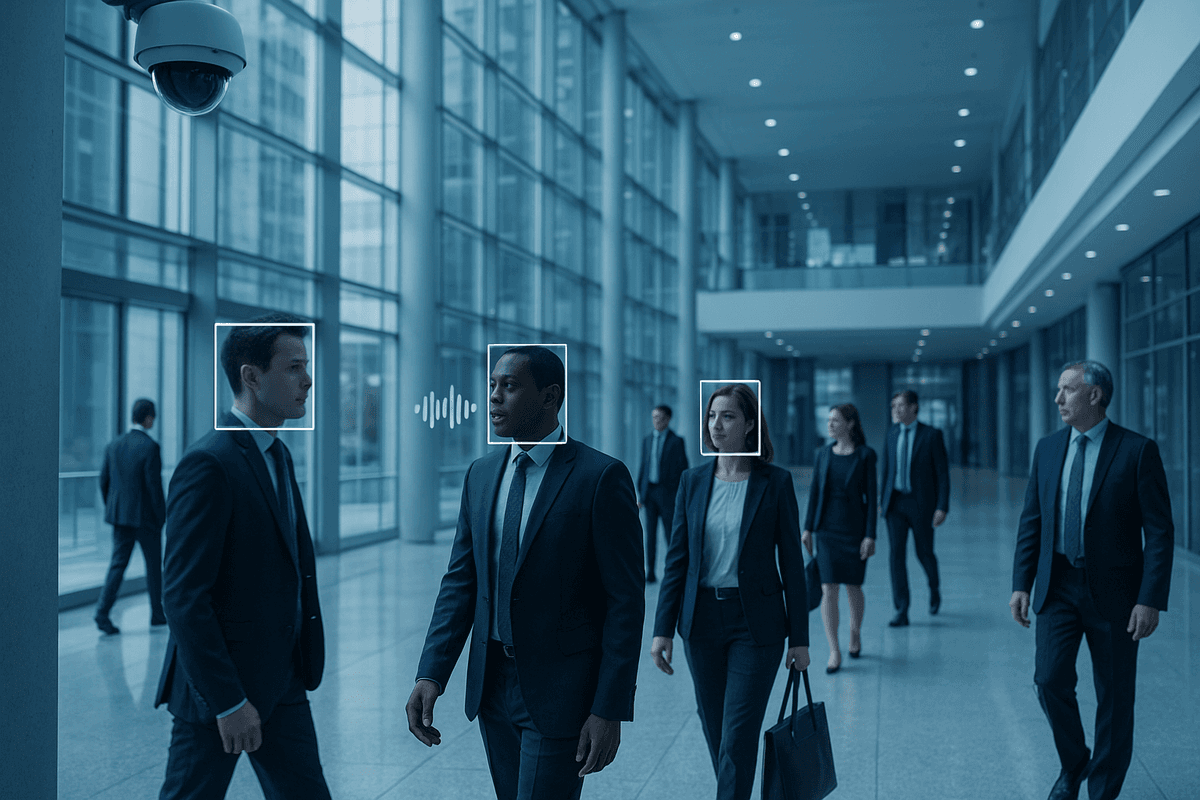
An attendance system is a combination of hardware and software that records when employees arrive and leave. A face recognition camera or an entry terminal identifies the person, the event is written to a server, and management sees who came in, who was late, and who is absent through a live dashboard and a Telegram bot. It replaces the paper log and manual timesheet arithmetic entirely.
Attendance tracking solves three specific problems: late arrivals that nobody notices, buddy-punching (one employee clocking in for another), and the month-end scramble to total up hours for payroll by hand. With face recognition there is no card or code to hand over — the camera identifies the person themselves, which is what makes the record defensible when somebody disputes it.
The recognition itself is a computer vision problem. If you want to understand the underlying technology — detection, embeddings, model training, and where else it applies — read our computer vision service page. This page is about the finished product: the attendance system you buy, install, and run.
What an attendance system is made of
A complete deployment has four moving parts: the identification hardware (camera or terminal), the server, the management dashboard, and the reporting channels.
Face recognition cameras
A camera at the entry point recognises the employee and logs attendance automatically — no card, no code, no touching a device. It keeps working when people wear glasses or head coverings.
Entry terminals
A device that records attendance by fingerprint, card, or PIN — the cheapest option for small teams. It is also used alongside face recognition as a second confirmation channel.
Real-time dashboard
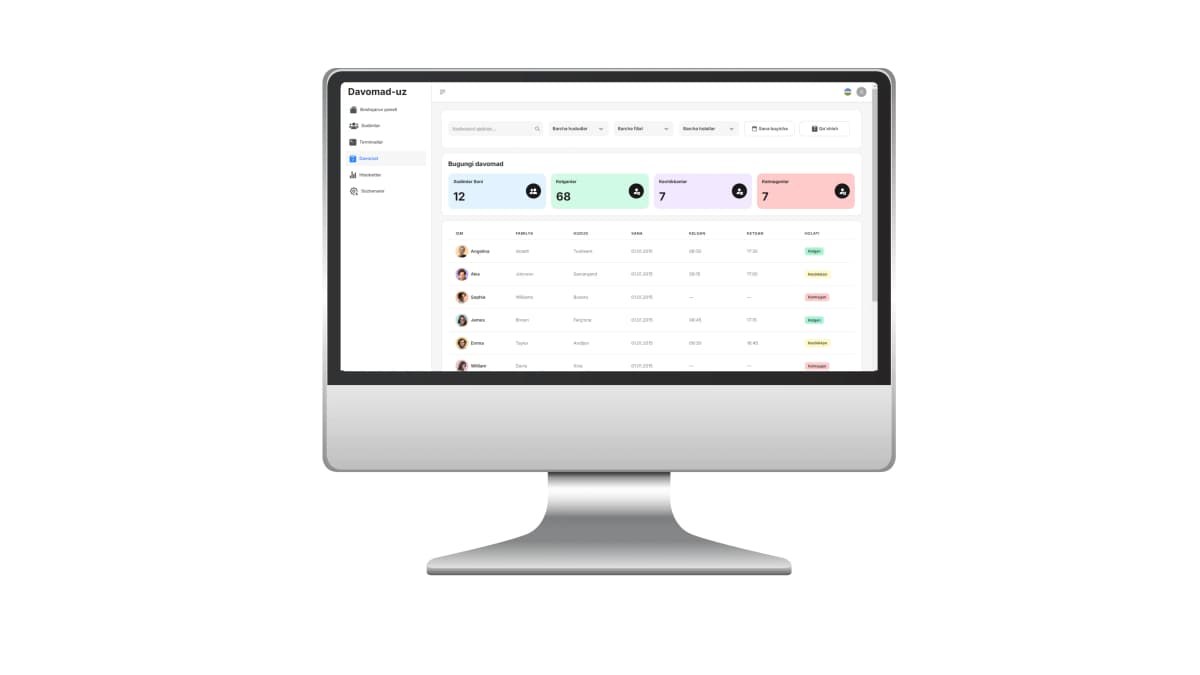
A control panel for managers and HR: who is on site right now, who arrived late, who has not shown up — live. Filtering by site and employee search are built in.
Reports and analytics
Daily, weekly, and monthly attendance reports: late arrivals, early departures, hours worked. Export to Excel and Google Sheets, formatted so payroll can use it directly.
Telegram notifications
Attendance events are pushed to a Telegram bot: arrivals, departures, lateness alerts, and the daily absentee list. The manager sees all of it on their phone.
Integrations
Payroll calculation through 1C, employee records synchronised with your CRM. Deployed on your own server (on-premise) or in the cloud, depending on your policy.
How the system works
From the moment an employee walks through the door to the notification on the manager's phone, the whole chain takes seconds.
Identification
The employee walks through the entry point — the camera recognises their face, or the terminal reads a fingerprint or card.
The event is recorded
Arrival and departure times are written to the server. If the connection drops, the event is buffered on the device and synced later.
The dashboard updates
HR and management see the live picture: who is in, who is late. Every event is compared against the configured shift rules.
Telegram gets the message
The bot notifies the manager immediately, and at the end of the day sends the consolidated attendance report.
Attendance system pricing
An attendance system in Uzbekistan costs between 8 mln and 60 mln UZS. The figure depends on headcount, the hardware type (terminal or face recognition camera), and the integrations you need. Below are the real package ranges and installation timelines we quote.
Updated: July 2026
| Package | What's included | Price (UZS) | Installation time |
|---|---|---|---|
| Basic attendance | Up to 20 employees, entry terminal (fingerprint or card), software, core reports | 8–12 mln UZS | 3–7 days |
| Standard face recognition | Up to 100 employees, face recognition camera, real-time dashboard, Telegram notifications | 18–25 mln UZS | 1–2 weeks |
| Premium AI monitoring | 1000+ employees, AI anomaly detection, multi-site dashboard, 1C and CRM integration | 40–60 mln UZS | 3–6 weeks |
What makes up the price?
The total has two components: hardware (cameras, terminals, and a local server where required) and software (dashboard, reports, Telegram bot, integrations). These are the factors that move the number:
- Headcount and the number of entry points
- Whether a terminal is enough or face recognition is required
- Whether your existing IP cameras can be reused
- Number of branches or sites (multi-site dashboard)
- 1C, CRM, and Telegram bot integrations
- On-premise server or cloud deployment
In the free consultation we survey your site and produce an itemised quote — hardware list, price, and delivery date included.
Telegram monitoring bot — attendance on your phone
Attendance results are pushed straight into a Telegram bot. Managers do not open a dashboard — they see who arrived, who was late, and who is missing on their phone.
Live notifications
An employee arrives or leaves and the bot posts it immediately. Late arrivals and early departures are flagged separately so they stand out from routine traffic.
The daily absentee list
Shortly after the shift starts, the bot sends the “not in today” list. Management knows the situation in the first minutes of the day without phoning around to find out.
Daily and monthly reports
A summary at the end of each day and an hours-worked report at the end of each month, delivered inside the bot — formatted so payroll can use it directly.
For schools: alerts to parents
In education, a Telegram notification goes to the parent the moment a student enters the building — confirmation that their child arrived, sent automatically.
The Telegram bot is installed together with the attendance system at no separate charge. If you also need a bot for the business itself — order intake, payments, CRM — that is a separate service we offer.
Telegram bot developmentAttendance bot
bot
✅ 08:52 — Aziza N. checked in
⚠️ 09:24 — Jasur T. arrived late (24 min)
📋 09:30 — Absent today: 2 employees
📊 18:30 — Daily report: 46/48 on site, 3 late arrivals
Real project: attendance tracking for a large enterprise
Everything on this page is something we have already built and handed over — not a specification we hope to fill one day.
Client
A large enterprise with a substantial workforce and several entry points. Delivered in 2024 over three months.
The problem
Attendance was being kept by hand. Arrivals, departures, late starts, and early finishes needed to be captured automatically and in a form nobody could argue with.
What we built
AI-based face recognition cameras plus dedicated terminals at the entry points, so employees are identified automatically as they pass through. Management tracks working hours, tardiness, and early departures through detailed reports and a management panel with real-time monitoring. Built with Python, OpenCV, React, PostgreSQL, and Docker.
Outcome
- Attendance is no longer recorded by hand — cameras and terminals log it automatically
- Late arrivals and early departures appear explicitly in the reports
- Management monitors working time through a real-time dashboard and detailed reporting
Paper log vs terminal vs AI camera
An honest comparison of the three methods. Many of our clients start with a terminal and move to face recognition later — the platform supports both, so the first purchase is not wasted.
| Criterion | AI face recognition camera | Terminal (fingerprint / card) | Paper log |
|---|---|---|---|
| Can it be cheated? | Effectively no — the camera identifies the person themselves | Card versions allow buddy-punching; fingerprint versions do not | Easily — any time can be written down after the fact |
| Accuracy of the record | Exact timestamp from the device clock, tied to a verified identity | Exact timestamp, tied to whoever presented the card or finger | Self-reported and rounded — the number is whatever was written |
| Speed at the door | Walk through without stopping | Each person stops at the device | Slowest — writing and signing, with a queue at peak times |
| Entry cost | Higher — from 18 mln UZS | Lower — from 8 mln UZS | Close to zero, but the hidden admin cost is large |
| Reporting | Automatic: dashboard, Telegram, 1C | Automatic: dashboard, Telegram, 1C | Manual totals at month end, with a high error rate |
| Best fit | Offices of 50+, manufacturing sites, schools | Small teams of 5–30 with a single entry point | Not recommended, even as a temporary measure |
Face recognition accuracy varies enormously between vendors and deployment conditions, which is why we never quote a single headline percentage. Independent benchmarks are published by the NIST Face Recognition Technology Evaluation. Because face templates are biometric data, deployments in organisations that handle EU data must also respect GDPR Article 9. For camera compatibility we rely on the open ONVIF Profile S and RTSP streaming standards, which is what lets us reuse most existing IP cameras.
Who attendance tracking is for
The system adapts to any organisation — shift rules and report formats are configured for your sector rather than forced on you.
Offices and companies
Lateness visibility, flexible-schedule accounting, and hours for payroll. It takes manual timesheet arithmetic off HR entirely.
Manufacturing
Rotating shifts, large headcount, several entry points. This is exactly the scale at which a paper log stops working and the system pays for itself.
Schools and training centres
Student attendance, Telegram notifications to parents, and reports per class or group. Teacher attendance is tracked as a separate stream.
Clinics and healthcare
On-call rota control and shift accounting for doctors and nurses. Precise hour counting matters most where pay is tied to shifts.
Retail chains
Several stores or branches in one dashboard. Each store manager sees their own team; head office sees the whole network.
Government and restricted sites
Fully on-premise installation: data never leaves your own server, and the system runs without an internet connection.
How an attendance system is deployed — 5 stages
From the site survey to team training. The Basic package is fully operational in 3–7 days, Standard in 1–2 weeks.
Site survey and requirements
1–2 daysWe review headcount, entry points, shift patterns, and existing infrastructure — cameras, network, servers. That produces a package recommendation and an itemised quote with a hardware list.
Hardware selection
1–3 daysFace recognition camera, terminal, or a combination — chosen against your entry points and budget. If your existing IP cameras meet the requirements, we use them and reduce the hardware cost.
Installation
Basic 1–2 days, Standard 3–5 daysCameras and terminals are mounted, the server (on-premise or cloud) is provisioned, and we test the network plus the offline fallback that keeps recording when connectivity drops.
Configuration and integration
1–4 daysThe employee database is loaded, face templates are enrolled, and shift rules and lateness thresholds are configured. The Telegram bot, 1C, and CRM are connected at this stage.
Team training
1 dayWe train HR and management on the dashboard, reports, and Telegram bot, and hand over written documentation. Technical support continues after go-live.
Ordered alongside attendance
Attendance is one piece of business automation. Most clients deploy it together with a Telegram bot and a CRM.
AI services overview
All of our AI solutions in one place — agents, computer vision, integration and attendance — with prices and timelines.
Compare solutionsTelegram bot development
Beyond attendance alerts: order intake, Payme and Click payments, and customer service bots.
Learn moreCRM development
Employee records, customers, and sales in one system — attendance data synchronises into it.
Learn moreAll services
Websites, mobile apps, AI agents, and the rest of what the Innosoft team builds.
BrowseAttendance systems — frequently asked questions
Short, direct answers on pricing, timelines, security, and the technical questions clients raise before signing.
Attendance systems in Tashkent, Uzbekistan
About the provider
Innosoft is a software development company in Tashkent, Uzbekistan, at Amir Temur 107B. We build employee attendance systems, computer vision solutions, Telegram bots, CRM platforms, mobile apps, and websites. Our attendance system combines AI-based face recognition cameras and entry terminals with a real-time dashboard and Telegram reporting; it was delivered for a large enterprise client in 2024 using Python, OpenCV, React, PostgreSQL, and Docker. Projects start at 8,000,000 UZS and are installed in 3 days to 6 weeks depending on scale. We work in Uzbek, Russian, and English — call +998 77 016 87 88 or use the contact page.
Companies in Uzbekistan usually come to us at one of two moments: headcount has grown past the point where a paper log is credible, or payroll disputes have started because nobody can prove what time somebody actually arrived. An employee attendance system fixes both by making the record automatic and the same for everyone.
We deliver the whole chain: the site survey, the hardware, the installation, the software, the integrations with 1C and your CRM, and the training that makes HR comfortable using it in week one. Because we build the software ourselves rather than reselling a boxed product, shift rules, lateness thresholds, and report formats are configured to how your organisation actually works.
If face recognition is the part you care about as a technology — model selection, training data, accuracy under poor lighting, other applications like object counting or quality inspection — that belongs on our computer vision page. Related services: Telegram bot development, CRM development, and the full services catalog.
Updated: July 2026